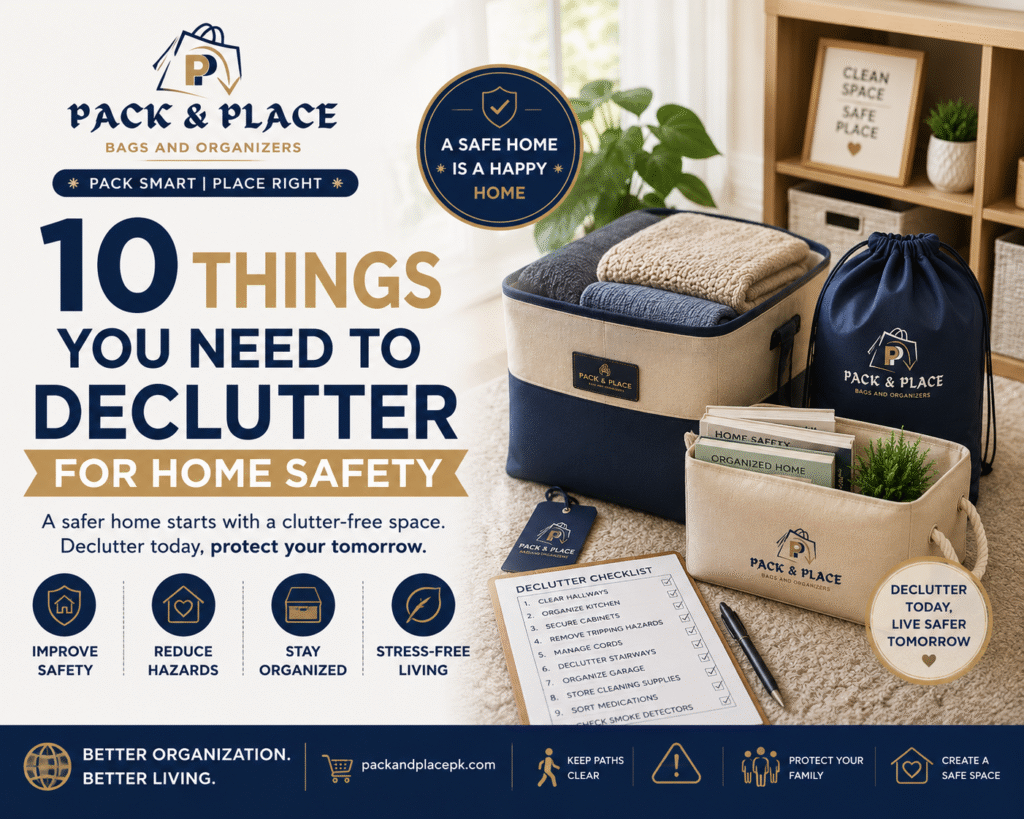
10 Things YOU need to Remove from Your Home Right Now for a Safer, Clutter-Free Life
Most home accidents don’t happen because of one dramatic mistake — they happen because of the things we’ve stopped noticing. In this guide, we’re sharing 10 specific items to remove as you declutter for home safety, plus smart storage solutions that keep every room organized and hazard-free.
It started with a near-miss. A pair of shoes left near the door. A bag half-hanging off the bottom stair. Nothing dramatic — just the ordinary clutter that builds up quietly in a busy home. You stop seeing it after a while. And that, honestly, is what makes it dangerous.
Most of us think of clutter as an aesthetic problem — something that makes the home look untidy. But clutter is also a physical hazard. Tripping risks, blocked pathways, unstable shelves — these are real issues that happen in real homes every single day.
The good news? You don’t need to renovate or spend a fortune. Decluttering for home safety is about making small, deliberate decisions room by room. In this guide, we’ll walk you through 10 specific things to remove — and, more importantly, smarter ways to store and organize what you keep so hazards don’t creep back in.
Why Decluttering for Home Safety Matters More Than You Think
Clutter accumulates gradually, which is exactly why it’s so easy to overlook. A pile of shoes by the front door grows over weeks. Bathroom products migrate to the floor because the shelf is full. Extension cords stretch across hallways because there isn’t a better option — yet.
None of it feels urgent until it is. Trips and falls are among the most common causes of household injuries, and the majority happen in rooms we use every day: bathrooms, bedrooms, hallways, and kitchens. The fix, in most cases, isn’t a major project. It’s removing the right things and replacing chaos with a storage system that actually works.
“Clutter you stop noticing is the most dangerous kind. It’s still there — you’ve just stopped seeing it as a problem.”
Let’s go room by room and identify exactly what needs to go.
10 Things to Remove from Your Home for a Safer Space
1.Loose Rugs and Mats Without Non-Slip Backing
A rug that shifts when you step on it is one of the most common tripping hazards in Pakistani homes — especially on marble, tile, or polished floors. In the bathroom, the risk doubles because the floor is wet. In hallways, children and older family members are most vulnerable.
If your rug slides even slightly underfoot, it needs to either go or be properly secured with non-slip backing. The floor should feel stable — not something you have to think about every time you walk across it.
Storage Tip: Replace loose mats with flat, grip-backed bath mats designed to stay put. For hallway rugs you love, use double-sided anti-slip mat tape underneath.
2.The Shoe Pile at Your Entrance
Every home has one. Sandals, sneakers, school shoes, house chappals — piled up near the front door in an arrangement that somehow makes sense to everyone in the house but is actually a significant tripping hazard. When you’re coming home in the dark, or rushing out in the morning, or carrying heavy shopping bags, that pile becomes a genuine obstacle.
The solution isn’t telling everyone to be tidier — it’s giving shoes a proper place to live. A structured shoe rack or hanging shoe organizer keeps footwear contained, accessible, and off the floor entirely.
Storage Tip: A vertical hanging shoe organizer on the back of your entrance door is one of the most space-efficient solutions for small homes. No floor space used, no pile to trip over.
3.Everything That Creeps Onto the Stairs
Library books waiting to go up. A sweater that didn’t quite make it. Bags set down “just for a moment” two days ago. Stairs become impromptu storage surfaces in most busy households — and we step around these things so often that they become invisible.
But stairs are one of the highest-risk areas in any home. Treat them as a strict no-drop zone. Nothing belongs on a step, even temporarily. It takes about a week to build the habit, and then it becomes automatic.
Storage Tip: Place a small basket or tray at the base of the stairs — a landing zone for things that need to go up. Empty it once daily. The stairs themselves stay permanently clear.
4.Products Stored on the Bathroom Floor
The bathroom floor around the tub and near the toilet is one of the most dangerous zones in any home — slippery when wet, and often cramped. Yet it’s exactly where extra shampoo bottles, loofahs, spare soap bars, and overflow products end up when bathroom shelving runs out of space.
Clear the floor completely. Move what’s necessary to proper in-shower storage or to a bathroom shelf or organizer. If floor overflow is happening regularly, it’s a signal that your bathroom storage system needs an upgrade — not just a tidy-up.
Storage Tip: A hanging shower caddy or over-the-door bathroom organizer can hold a surprising amount without using a single square inch of floor space.
5.Extension Cords Running Across Walkways
One cord running behind the sofa. One crossing the bedroom to reach the lamp. Another in the hallway because the nearest socket isn’t close enough. We know they’re there — but knowing and seeing clearly are very different things, especially in low light or when carrying something.
Reroute what you can along walls and baseboards. Use socket extenders where practical. Remove items that require long cords just to reach a power source.
Storage Tip: Cable management clips or cord covers allow you to run cables neatly along skirting boards, making them both safer and visually cleaner.
6.Anything Balanced Precariously on Shelves
Overstuffed shelves — in the kitchen, the bedroom wardrobe, the linen cupboard — where things sit at the edge or lean against each other to stay upright. The risk here isn’t just that something falls on you (though that does happen). It’s also that reaching for something on an overstuffed shelf throws off your balance.
Go through each shelf systematically. If it hasn’t been used in over a year, it leaves. What remains goes back in a stable, easy-to-reach arrangement. Nothing at the very edge.
Storage Tip: Storage bags and vacuum compression bags are a game-changer for shelf space. Bulky items like extra bedding take up a fraction of the space, leaving shelves clear and stable.
7.Furniture Blocking Your Path to the Bathroom at Night
A decorative stool at the foot of the bed. A side table between the bed and the door. During the day, neither feels like a problem. At 2am, half asleep, navigating around them in the dark is a different story entirely.
Clear the path from your bed to the bathroom completely. Rearrange or remove any furniture that interrupts it. This single change makes your bedroom significantly safer — especially for children and older family members.
Storage Tip: Instead of a separate stool or table for nighttime essentials (water, glasses, phone), use a bedside organizer or under-bed storage caddy that keeps items accessible without obstructing the floor.
8.The Clutter Beside and Under Your Bed
Slippers, a bag set down two days ago, books that didn’t make it to the nightstand, charger cables sprawled across the floor. The area immediately beside the bed is the first thing your feet encounter when you get up — it should be completely clear, every night, without exception.
Under-bed storage is one of the most underused spaces in Pakistani homes. With the right organizers, it becomes a smart home for seasonal items, freeing up the visible bedroom from clutter while keeping the floor safe.
Storage Tip: Flat, zippered storage bags with handles are perfect for under-bed use — they keep items dust-free, organized by category, and easy to slide in and out.
Ready to upgrade your storage? From vacuum compression bags to under-bed organizers and hanging shoe racks, Pack & Place has everything you need to keep your home both safe and beautifully organized. Browse our full range of storage solutions on Daraz — organized living, delivered to your door.
9.Paper Piles, Mail Stacks, and Magazines on Flat Surfaces
Paper doesn’t trip you — but it does something more subtle. It takes over flat surfaces in a way that spreads clutter, attracts more items on top of it, and makes the home feel more disorganized than it actually is. When surfaces feel chaotic, we tend to move through them less carefully.
Sort the paper pile once — keep what matters, discard what doesn’t — and create a simple ongoing system so new paper has a designated place instead of landing wherever there’s space.
Storage Tip: A small file organizer or document holder keeps important papers contained without cluttering surfaces. For magazines, a slim magazine holder keeps them upright and accessible rather than piled flat.
10.Items You’ve Been Meaning to Fix, Move, or Donate
The wobbly step stool you’re careful with every time. The broken chair that’s been “out of the way” for months. The bag of donations sitting by the door for two weeks. These in-between items — things that are neither properly in use nor properly gone — are a unique category of clutter. They take up physical and mental space, and they tend to stay exactly where they are until something forces a decision.
Make the decision today. A wobbly stool is not a minor annoyance — it’s a real hazard. A bag of donations becomes a tripping hazard every single day it sits by the door. Resolve each item: repair it, remove it, or find it a proper home.
Storage Tip: For items earmarked for donation, use a dedicated labeled storage bag in one spot — away from walkways. When it’s full, it goes. No ongoing floor clutter, no forgotten piles.
🗒 Your Quick Declutter for Home Safety Checklist
- Loose rugs replaced or properly secured with non-slip backing
- Shoe pile at entrance moved to a rack or organizer
- Stairs completely clear — no-drop zone established
- Bathroom floor empty — products moved to shelves or caddies
- Extension cords rerouted along walls, not across walkways
- Shelves decluttered — nothing balanced at the edge
- Clear path from bed to bathroom — furniture rearranged if needed
- Floor beside bed completely clear every night
- Paper piles sorted and a simple ongoing system in place
- Broken or in-limbo items repaired, donated, or removed
A Safe Home Doesn’t Happen by Accident
None of the changes on this list require a renovation, a big budget, or a full weekend. They require honest attention — the kind of fresh look you take when you stop accepting things as “just how the house is.”
Decluttering for home safety is one of the most practical things you can do for your family. It protects children who run through the house without watching the floor. It protects older family members navigating the bathroom at night. It protects everyone — because hazards don’t announce themselves before they cause harm.
The other thing that happens when you clear these hazards? Your home feels calmer. Cleaner. More livable. Organization and safety aren’t separate goals — they support each other, and the right storage solutions make both possible.
Start with one room. Do one item from the checklist today. The momentum builds faster than you expect.
Ready to Make Your Home Safer and More Organized?
Pack & Place has the storage bags, organizers, and space-saving solutions you need — designed for real Pakistani homes. Shop on our website or find us on Daraz for fast delivery.